Rialto Apt Evacuation “Relocation Checks” BOUNCING!
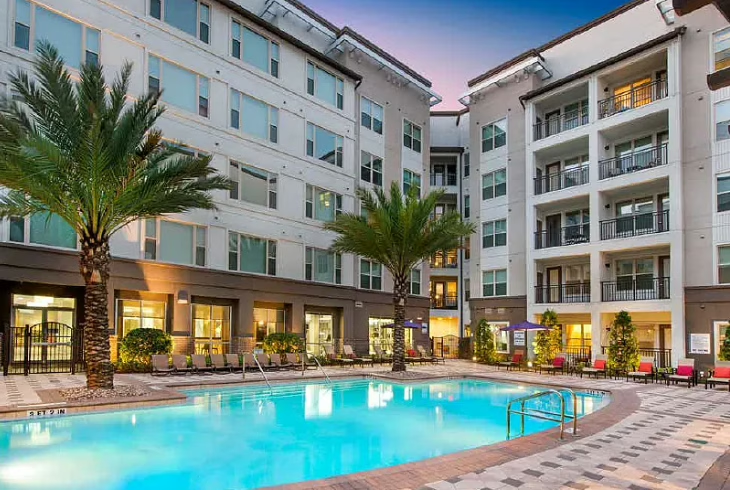
Located at 7343 W Sand Lake Rd, Orlando, FL 32819
Structural Failure Displaces Hundreds: Renters Insurance Don’t Have To Pay.
By SyndicatedNews Real Estate | SNN.BZ
Orlando, Florida – More than 350 residents of The Rialto Apartments in Orlando’s Dr. Phillips area were abruptly evacuated in the early hours of March 19 after hearing loud popping noises, discovering jammed doors, and spotting cracks throughout the five-story building. What began as a frightening 911 call from a resident fearing imminent collapse quickly escalated into a full-scale emergency, with Orange County Fire Rescue and building inspectors deeming the complex structurally unstable.
The Rialto, a mixed-use property at 7343 W. Sand Lake Road featuring ground-floor retail and roughly 200 apartment units, was built in 2014. It had passed its most recent annual inspection in September with no noted structural issues. Yet within hours on March 19, cracks appeared on every floor, doors seized shut, and the entire complex was ordered evacuated. Residents grabbed what they could and left, many ending up in hotels arranged by emergency management and the Red Cross.
Subsequent engineering investigations have pinpointed the likely cause: differential settlement—the uneven sinking of portions of the building. A preliminary report released this week by structural engineers from Simpson Gumpertz & Heger revealed a significant void beneath the structure: a gap approximately three feet deep and up to 15 feet wide between the soil and the ground-level slab under a load-bearing wall. The engineers have ordered temporary shoring to stabilize the affected areas while a full repair plan is developed. Orange County’s Division of Building Safety has posted “no occupancy” notices, and the building remains closed indefinitely pending permitted repairs and reinspection.
While the building has not catastrophically collapsed, the sudden ground movement created dangerous conditions that made continued occupancy impossible. Experts, including engineering professors consulted by local media, describe the “popping” sounds as the structure shifting under excessive stress from the settling foundation.
Insurance Companies Largely Off the Hook for Tenants’ Losses
For many displaced residents, the financial fallout is compounded by a harsh reality: their renters insurance policies are unlikely to cover additional living expenses or personal property losses in this scenario.
Insurance experts and policy language reviewed by tenants reveal a common exclusion. Most standard renters policies define “collapse” narrowly—requiring an actual, total structural failure. A building that is still standing, even with visible cracking, bulging, sagging, or bending, typically does not qualify as a covered collapse. Coverage often hinges on the exact cause of the damage. Some policies include “catastrophic ground cover collapse” (Florida’s term for large, sudden sinkhole-like events), while sinkhole coverage itself is usually optional and separate. Water damage or gradual soil issues are frequently excluded.
One tenant, Ross Ruppel, told WESH 2 News he filed a claim immediately but was informed that an engineer’s report on the root cause would be required—and even then, approval was far from guaranteed. “I got insurance thinking that I’d be covered for something like this,” another resident, Leonidas Papakalos, said. An insurance agent reportedly told one tenant, “You’d better hope it’s a sinkhole.”
Tanya Rodriques, owner of Evolve Insurance Group in Maitland, confirmed to reporters that coverage “varies policy to policy.” Some provide limited “loss of use” benefits for temporary housing, but only if the peril is explicitly covered. Residents have been advised to keep every receipt, but many remain in limbo, facing hotel bills, moving costs, and the sudden need to find new permanent housing.
Landlord Response and Legal Action
The property is owned and operated by Northland Investment Corp., a Massachusetts-based private equity firm. In the immediate aftermath, the company stated it would provide each displaced household a one-time $1,000 payment to help with expenses and would not charge rent for days the units were uninhabitable. However, some residents reported that the checks bounced, prompting further frustration.
A class-action lawsuit has been filed against Northland Rialto, LLC, accusing the owners of negligence and breach of contract for failing to maintain the property in a habitable condition. Tenants argue the sudden failure—possibly linked to recent construction work around the pool and site—should have been preventable.
As of early April 2026, the building remains empty, temporary shoring is underway, and residents are scattered—some in temporary housing, others already relocating to new apartments. County officials and engineers continue to monitor the site, with no firm timeline for repairs or reoccupancy.
The Rialto case has drawn comparisons to other Florida structural incidents, including the 2021 Surfside condominium collapse, prompting renewed questions about building maintenance, soil stability in Central Florida, and the adequacy of insurance protections for renters facing sudden, non-catastrophic failures. For now, hundreds of families are left bearing the financial and emotional burden while the building—and the insurance claims—remain in limbo.
Insuraance coverage varies dramatically insurer to insurer. Some insurance companies covered hotel stays, most will cover nothing until the engineering report comes out which could be months.