Easter Sunday, Passover, Pesach
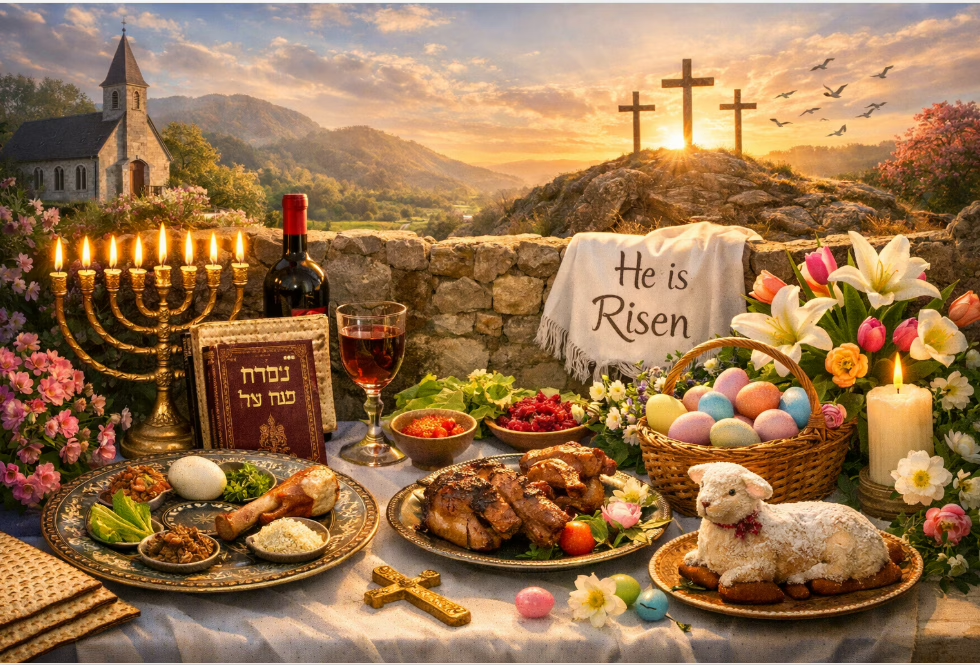
Two of the most significant religious observances in Christianity and Judaism
By SyndicatedNews Faith | SNN.BZ
Their connection runs deeper than shared timing or symbolism. Across centuries—especially in the Iberian world and later in Latin America—their overlap shaped lived experiences, cultural practices, and even strategies for survival among Jewish communities.
At their core, both Easter Sunday and Passover center on liberation and renewal. Passover recalls the Israelites’ escape from bondage in Egypt, while Easter celebrates the resurrection of Jesus Christ and spiritual redemption. These themes already link the two observances conceptually, but history brought them into even closer contact.
That connection becomes especially vivid when considering Good Friday—known in Spanish as Viernes Santo. This solemn day, commemorating the crucifixion of Jesus, often falls during the same period as Passover due to their shared reliance on lunar calendars. In Catholic-majority societies, particularly those shaped by Spanish and Portuguese influence, Good Friday developed into a highly visible public observance marked by processions, fasting, and strict social expectations.
For Sephardic Jews—the descendants of Jews expelled from Spain and Portugal in the late 15th century—this overlap was not merely calendrical; it was deeply consequential. Following the Spanish Inquisition and the forced conversions that created communities of conversos (Jews who outwardly adopted Christianity), many Sephardic Jews carried their traditions into the Americas. There, under colonial Catholic rule, public expressions of Judaism were dangerous or outright forbidden.
In this context, Viernes Santo and Passover became intertwined in complex and often hidden ways. Holy Week—culminating in Good Friday—was a time of intense scrutiny in colonial Latin American societies. Authorities and neighbors alike were attentive to religious conformity. For crypto-Jewish families (often called anusim), this meant carefully navigating the overlap between Catholic observance and Jewish ritual.
Many adapted by blending or disguising practices. For example, Passover dietary restrictions—such as avoiding leavened bread—could sometimes be concealed within the broader culture of fasting and abstinence associated with Good Friday. Lighting candles for Passover or maintaining certain household customs might be reframed to resemble Catholic devotional acts. In some cases, the very intensity of Holy Week provided cover: since everyone was focused on Catholic rituals, subtle deviations could go unnoticed if handled carefully.
Across Latin America—from regions of Mexico and the Caribbean to parts of South America—these Jewish communities often made a deliberate choice to remain “beneath the radar,” both socially and politically. This was not merely caution; it was a survival strategy shaped by generations of persecution. Public life required outward conformity to Catholic norms, especially during highly visible धार्मिक periods like Holy Week. Privately, however, families preserved fragments of Jewish identity, passing down customs, prayers, and dietary habits in coded or modified forms.
Over time, this created a unique cultural layering. Good Friday processions and Passover remembrance existed side by side, sometimes within the same households but expressed in entirely different registers—one public and performative, the other private and guarded. The overlap of these observances reinforced a dual identity for many Sephardic descendants: outwardly Catholic, inwardly connected to Jewish heritage.
Even in later centuries, as religious tolerance gradually increased in parts of Latin America, the legacy of secrecy persisted. Traditions that originated as protective measures became embedded cultural habits. Only in more recent generations have some descendants of these communities begun to openly rediscover and reclaim their Jewish roots, reconnecting Passover practices with their historical origins.
In this way, the relationship between Easter, Good Friday, and Passover is not just theological or historical—it is deeply human. It tells a story of resilience under pressure, of faith maintained in quiet ways, and of how overlapping sacred calendars shaped the rhythms of life for entire communities.
In the spirit of Easter Sunday and Passover, we can share a unified message of hope and blessing across cultures: Happy Easter and may God bless you—Feliz Pascua y que Dios te bendiga—חג פסח שמח ואלוהים יברך אותך (Chag Pesach Sameach ve’Elohim yevarech otcha).