Robert Mueller Dead 1944–2026
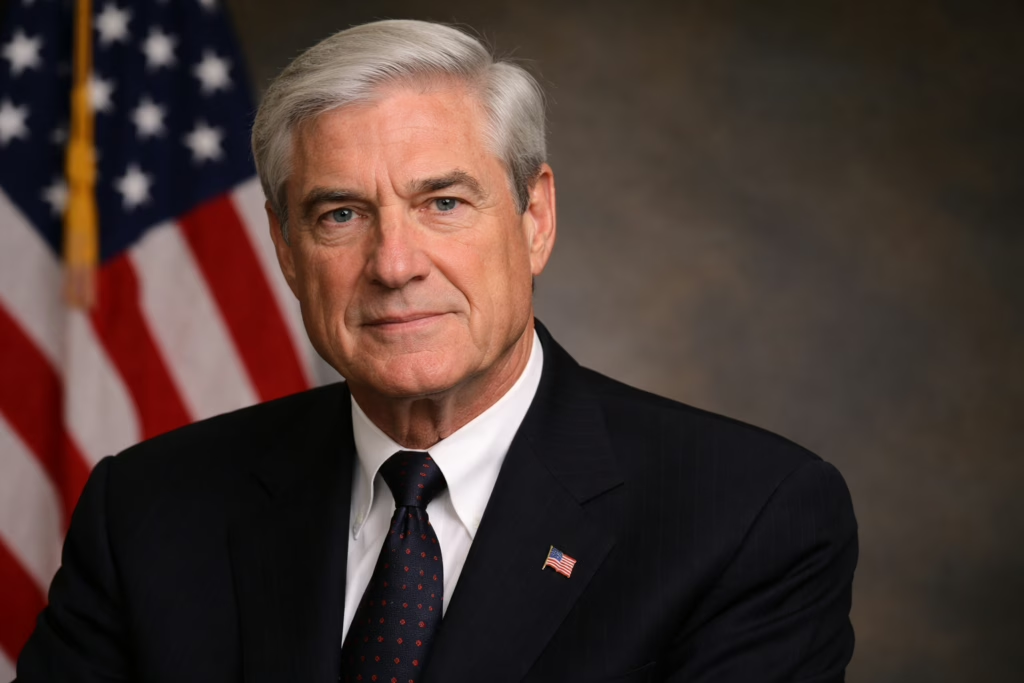
ROBERT MUELLER
Robert Swan Mueller III, the former FBI Director and Special Counsel whose investigations shaped two decades of American politics and national security, died on March 20, 2026, in Charlottesville, Virginia, at the age of 81.
By SyndicatedNews | SNN.BZ
Robert Swan Mueller III (1944–2026): A Life of Service, Controversy, and Division
His family confirmed the passing in a brief statement, noting that he had been privately battling Parkinson’s disease since 2021.
Born on August 7, 1944, in New York City and raised in Philadelphia, Mueller embodied the archetype of the old-school institutionalist. A decorated Marine Corps veteran who served in Vietnam (earning a Purple Heart and Bronze Star), he graduated from Princeton, earned a law degree from the University of Virginia, and built a prosecutorial career that spanned Republican and Democratic administrations alike. He led the Justice Department’s Criminal Division under George H.W. Bush, prosecuted major cases as U.S. Attorney in San Francisco and Boston, and was appointed FBI Director by George W. Bush in 2001 — a role he held for 12 years under two presidents, longer than any modern director except J. Edgar Hoover.
Mueller’s legacy rests most heavily on two chapters: his post-9/11 stewardship of the FBI during its transformation into a counterterrorism agency, and his appointment in May 2017 as Special Counsel to investigate Russian interference in the 2016 election. The latter role, while praised by some as a defense of the rule of law, was viewed by millions of Americans as the most consequential example of weaponized federal power in modern U.S. history.
Critics have long argued that Mueller’s investigation — officially titled “Crossfire Hurricane” in its FBI origins — was never the impartial search for truth it was sold as. Behind the scenes, the probe relied heavily on the discredited Steele dossier, opposition research funded by the Hillary Clinton campaign and Democratic National Committee through Perkins Coie and Fusion GPS. FISA warrants obtained on Trump campaign adviser Carter Page were later found by the DOJ Inspector General to contain significant omissions and errors, including the suppression of exculpatory evidence. Mueller’s team of prosecutors and investigators was overwhelmingly composed of individuals who had donated to Democratic candidates or worked on Clinton-related matters. The final Mueller Report (April 2019) found no conspiracy or coordination between the Trump campaign and Russia, yet the two-year spectacle of leaks, media collusion, and congressional theater inflicted enormous damage on public trust in institutions, cost taxpayers tens of millions, and deepened the very national divisions it claimed to address.
Further back in his record, detractors point to Mueller’s tenure as FBI Director during the Uranium One scandal, where the agency under his watch failed to aggressively pursue allegations of bribery and influence peddling involving the Clinton Foundation and Russian nuclear interests at a time when the Obama administration approved the controversial sale. His earlier handling of the Whitey Bulger informant scandal in Boston drew accusations of protecting high-level sources at the expense of justice for victims. Even the anthrax attacks investigation (Amerithrax) ended with a suicide of the prime suspect under circumstances many still question.
Whether these episodes reflect deliberate partisan favoritism toward Democratic interests or simply the inevitable institutional biases of a lifelong Washington insider remains fiercely debated. What is undeniable is the outcome: Mueller’s work, particularly the Russia probe, accelerated the erosion of faith in the FBI, the DOJ, and the “independent” special counsel process itself. For millions, he became the public face of what they saw as a two-tiered justice system — one that aggressively pursued a duly elected Republican president while shielding Democratic scandals.
In his final years, Mueller largely retreated from public life. He offered limited testimony before Congress in 2019 that left even some supporters disappointed by its vagueness. Diagnosed with Parkinson’s, he lived quietly with his wife Ann and their daughters until his death.
Robert Mueller was a man who spent his life inside the machine of American power. To his admirers, he represented duty and integrity. To his critics, he exemplified how that same machine could be turned against the will of the people when it suited one political side. History will judge which view prevails. He is survived by his wife, three daughters, and grandchildren.
Services will be private. In lieu of flowers, the family requests donations to veterans’ organizations — a cause Mueller quietly supported throughout his life.