Gabrielle “Sam” Linehan unprotected – Career criminal’s rights protected

Gabrielle (Sam) Linehan Murdered In Her Car
It is with profound sadness that we reflect on the life and untimely death of Gabrielle “Sam” Linehan, a 28-year-old former Team USA synchronized figure skater and beloved coach whose grace, talent, and dedication left an indelible mark on the St. Louis skating community. 1997 – 2026
By SyndicatedNews Sports | SNN.BZ
On February 11, 2026, Sam was waiting in her car at a Starbucks drive-thru in the Tower Grove East neighborhood when her life was violently ended in a senseless act. SNN.BZ has waited until the last Freedom of Information Application results were released and Gabrielle’s family could have their service this past Saturday before we published this article.
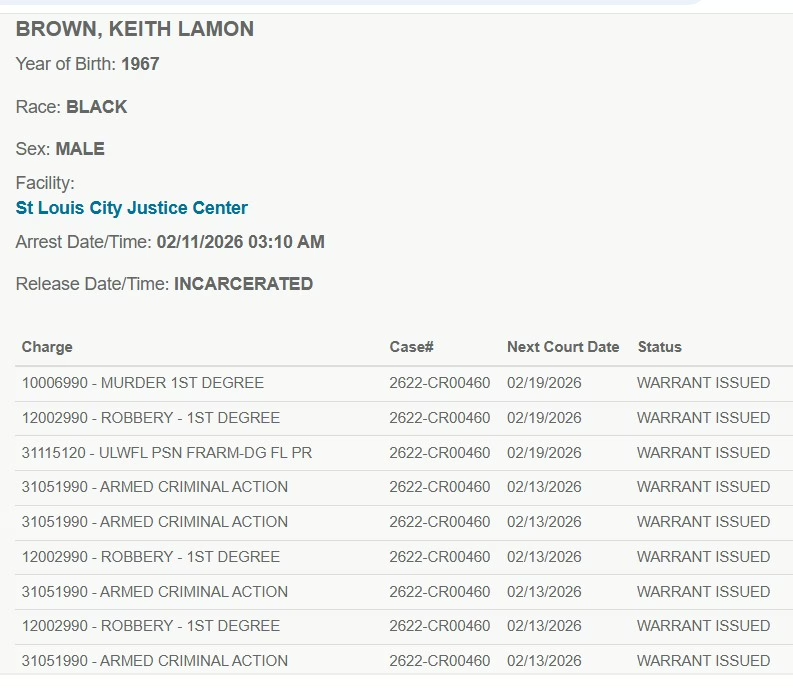
Gabrielle “Sam” Linehan was fatally shot by Keith Lamon Brown, 58, a career criminal with a rap sheet stretching back to 1986. Brown, who had prior convictions for robbery, burglary, and armed criminal action—including lengthy prison terms of 15 years and later 30 years—had been paroled, later became a parole absconder, and was wanted in connection with multiple armed robberies in the days leading up to the shooting. He now faces charges of first-degree murder, three counts of first-degree robbery, four counts of armed criminal action, and unlawful possession of a firearm as a convicted felon. He remains held without bond.

Sam was an accomplished athlete who represented Team USA from 2013 to 2015 as part of the St. Louis Synergy synchronized skating team. In 2014, she helped her junior team capture a silver medal at the U.S. Synchronized Skating Championships. After retiring from competition, she found her calling as a coach and mentor at the Metro Edge Figure Skating Club in Webster Groves and with St. Louis Synergy. Colleagues and students remember her as a naturally gifted instructor, a supportive friend, and a warm presence whose passion for the sport extended far beyond the ice. That ordinary Tuesday morning, she had been heading to watch the Olympics with friends—a small joy in a life defined by excellence and kindness. Her death is an incalculable loss to her family, her young athletes, the skating world, and everyone she touched. A vibrant woman full of promise was gone in an instant.
This heartbreaking tragedy has become a stark, human illustration of the complex challenges facing criminal justice reform in the United States today. The U.S. system confines roughly 2 million people daily, with an incarceration rate still among the highest in the developed world, though it has declined about 22% from its 2009 peak. Annual spending exceeds $180 billion. Reform efforts—spanning sentencing reductions, bail changes, expanded parole and reentry programs, and efforts to reduce collateral consequences—aim to lower costs, enhance fairness, and improve public safety, particularly for low-level, non-violent offenders.
Bipartisan initiatives like the 2018 First Step Act have delivered measurable successes: thousands of sentence reductions, expanded rehabilitation programming with documented lower recidivism for participants, and compassionate release for appropriate cases. Many states have mirrored these steps with drug courts, diversion programs, record-clearing, and “second-look” resentencing. Evidence shows that for first-time or lower-risk individuals, treatment-focused alternatives and earned-time credits can safely shrink unnecessary incarceration while maintaining or improving outcomes.
Yet cases like Sam Linehan’s death underscore the limits and risks of broader reform when applied without rigorous differentiation. Violent and career offenders—who make up the majority of state prisoners—have higher recidivism rates, and repeated failures of supervision for high-risk individuals (including parole absconders with decades of serious convictions) can lead to preventable tragedies. Brown’s history exemplifies how dangerous repeat offenders can cycle through the system despite prior serious offenses. In an era when many reform efforts seek to lessen the stigma attached to criminal records and prioritize reintegration, Sam’s passing stands as a painful reminder of the human cost when public safety is not placed foremost—when high-risk individuals are allowed to roam free among society and commit further crimes.
Data-driven analysis supports a pragmatic, risk-stratified approach rather than ideological extremes. For non-violent or low-risk cases, robust diversion, cognitive-behavioral programs, vocational training, and community supervision have proven effective at cutting recidivism and costs. For high-risk violent repeat offenders—those with chronic armed-robbery, firearm, or violent histories—longer incapacitation, stricter enforcement of parole conditions, and validated risk-assessment tools that weigh criminal history heavily are essential to protect innocent lives. National crime trends reflect this nuance: violent crime spiked sharply in 2020–2021 in some jurisdictions amid certain policy shifts before declining sharply to near historic lows by 2024–2025, while overall incarceration has stabilized or modestly rebounded in targeted areas.
Sam Linehan’s legacy of mentorship and excellence endures through the young skaters she inspired and the community she strengthened. In her memory, donations may be directed to the Metro Edge Figure Skating Club scholarship fund to support the athletes she loved. Her death does not argue against smart reform; it demands better reform—reform that incapacitates the truly dangerous, rehabilitates those who can change, holds everyone accountable proportionally, and above all prevents future victims. Public safety and justice are not opposing goals. When guided by evidence and differentiated risk rather than blanket leniency or unchecked severity, they reinforce each other. Tragedies like this one remind us why that balance matters so deeply.